After nearly two decades of negotiations, the world’s largest democracies are poised to create a 2-billion-person market as geopolitical pressures accelerate the push for closer ties
India and the European Union are on the verge of finalizing what officials are calling “the mother of all deals”—a sweeping free trade agreement that would unite nearly a quarter of the world’s population and GDP in one of history’s most significant trade pacts.
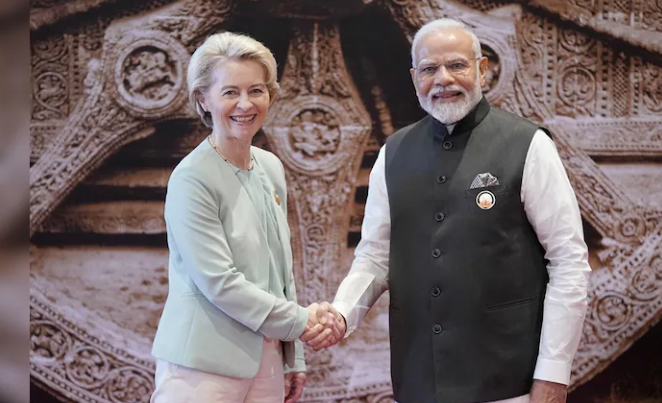
European Commission President Ursula von der Leyen and European Council President António Costa arrive in New Delhi on Saturday for a three-day state visit. They will join India’s Republic Day celebrations on Sunday as guests of honor before sitting down with Prime Minister Narendra Modi on Monday for the 16th EU-India Summit, where the deal is expected to be announced.
“We’re on the cusp of a historic trade agreement,” von der Leyen declared at Davos last week. “One that would create a market of 2 billion people, accounting for almost a quarter of global GDP.”
Twenty Years in the Making
The agreement would cap negotiations that first launched in 2007, stalled in 2013, and were revived in 2022. Of the 24 chapters under discussion, 20 have now been finalized, with negotiators working around the clock on remaining sticking points including the EU’s carbon border tax on steel and pharmaceutical safety standards.
Agriculture—a politically explosive issue on both sides—has been deliberately excluded from the deal, allowing negotiators to sidestep battles over India’s protected dairy and grain sectors and Europe’s sensitive farm lobby.
For the EU, the prize is access to one of the world’s most protected markets. India maintains some of the highest tariffs globally on products where Europe holds competitive advantages: cars, machinery, chemicals, wines, and spirits.
For India, the deal offers easier entry for its booming textile and pharmaceutical exports—and arrives at a critical moment. The EU withdrew tariff preferences on 87% of Indian goods effective January 1, while Washington has slapped 50% duties on Indian exports, making new markets essential.
Beyond Trade: Security and Defence
The summit will deliver far more than a commercial agreement.
India and the EU are expected to unveil a Security and Defence Partnership—a framework that could pave the way for joint production of military equipment. The pact would deepen cooperation on maritime security, cybersecurity, and counter-terrorism.
The timing is no accident. India has relied on Russia for decades for critical military hardware, but has been working to diversify its suppliers since Moscow’s invasion of Ukraine complicated that relationship. Europe, meanwhile, is racing to reduce its own dependence on American defense systems amid transatlantic tensions.
“We’re ready to open a new chapter in EU-India relationships,” an EU official said, “and really to unlock what we think is the transformative potential of this partnership.”
A mobility agreement to ease movement for students, researchers, seasonal workers, and skilled professionals is also on the table, alongside a comprehensive strategic vision governing the relationship through 2030.
Geopolitics Driving the Deal
The sudden urgency behind talks that languished for two decades reflects a dramatically changed world.
President Trump’s tariff threats—most recently over Greenland—have rattled both Brussels and New Delhi. China’s growing assertiveness has pushed both powers to seek alternatives to Beijing-centric supply chains. Russia’s war in Ukraine has scrambled old alliances.
“The EU and India are moving closer together at a time when the rules-based international order is under unprecedented pressure through wars, coercion and economic fragmentation,” EU foreign policy chief Kaja Kallas said this week.
For Europe, the summit offers a chance to turn the page after a bruising week of transatlantic drama. For India, it reinforces the “multi-alignment” strategy that has defined Modi’s foreign policy—maintaining ties across rival blocs rather than choosing sides.
The Stakes
Bilateral trade in goods reached €120 billion ($140 billion) in 2024—up nearly 90% over the past decade. Trade in services added another €60 billion.
Yet India still accounts for just 2.5% of total EU goods trade, compared with 15% for China—a gap that underscores the vast untapped potential.
“This would provide a first-mover advantage for Europe with one of the world’s fastest growing and most dynamic economies,” von der Leyen said.
Following the Mercosur agreement, an India deal would mark another major strategic win for Brussels as it seeks to diversify partnerships amid an increasingly fractured global order.
Once negotiations conclude, both sides will need to complete internal approval processes. EU ratification typically takes about a year, meaning tangible benefits for exporters remain some distance away.
But after two decades of false starts, the finish line is finally in sight.
The EU-India Summit takes place January 27 in New Delhi.