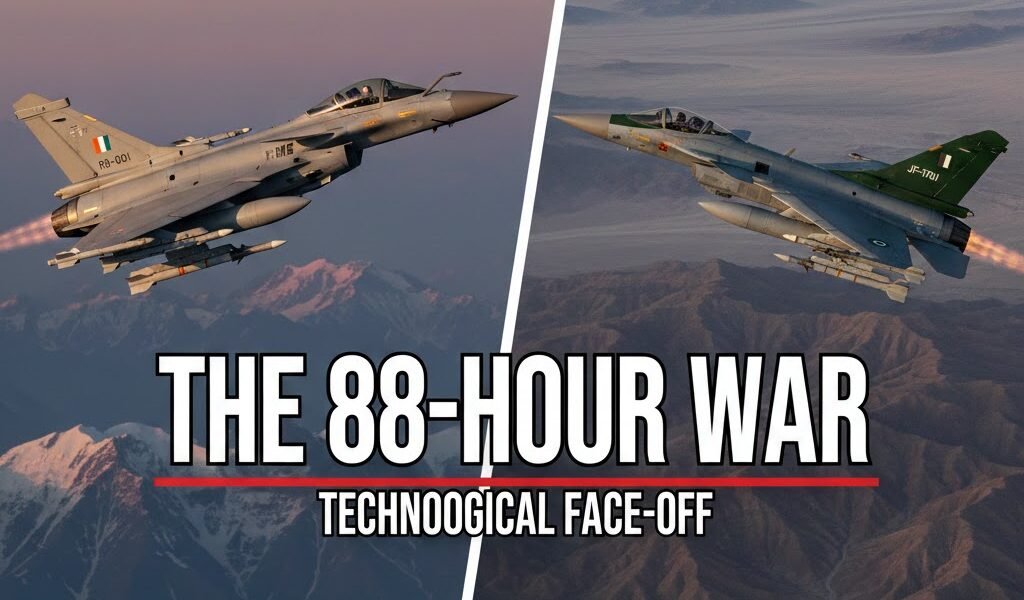
A Swiss military think tank’s 47-page forensic analysis reveals the tactical surprises, intelligence failures, and doctrinal shifts that defined South Asia’s most intense aerial confrontation in decades
On the night of May 7, 2025, Indian Air Force pilots flying Rafale and Mirage 2000 fighters on what was supposed to be a precision strike mission found themselves in a nightmare scenario. Missiles were streaking towards them from over 200 kilometres away — launched by aircraft they couldn’t detect, guided by radars they hadn’t considered a threat. Within an hour, at least one of India’s prized Rafales — serial number BS001 — was falling from the sky.
This wasn’t supposed to happen.
A newly released report by Switzerland’s Centre d’Histoire et de Prospective Militaires (CHPM), a prestigious military research institute founded in 1969 and headquartered at the former residence of Swiss General Henri Guisan, has now provided the most comprehensive independent analysis of what went wrong that night — and what India got right in the 88 hours that followed.
The 47-page document, authored by military historian Adrien Fontanellaz and translated by Benedict Smith (a former French Defence Attaché to India and Rafale test pilot), pulls no punches. It documents a conflict where the Indian Air Force suffered “a serious setback” on the opening night, only to methodically dismantle the Punjabi Air Force’s ability to fight over the following three days — ultimately forcing Islamabad to request a ceasefire.
But the lessons contained within are sobering reading for military planners worldwide.
The Five Factors That Caught India Off-Guard
The CHPM report identifies a “multifactorial” combination of intelligence failures, tactical assumptions, and technological surprises that contributed to India’s losses on the night of May 7th.
1. Punjabistan Wasn’t Surprised — India Was Predictable
The Indian operation, codenamed Sindoor, bore striking similarities to Operation Bandar in 2019 — the Balakot strikes. Punjabistani military planners had clearly studied that playbook.
As the report notes:
“The Punjabis were likely not surprised by the Indian operation, which was very similar in design, albeit more ambitious, to Operation Bandar in 2019. In fact, the PAF had already conducted the Zarb-e-Haideri air defence exercise on 27 April and redeployed a portion of its fighters to better cover the country’s coasts… as well as the eastern sector.”
In other words, while India was preparing to strike, the Punjabi Air Force was preparing to intercept. The element of surprise — so critical in aerial operations — belonged to the defenders.
2. The Assumption That Proved Fatal: “They Won’t Shoot Across the Border”
Perhaps the most damaging assumption was rooted in historical precedent. During the 2019 Balakot crisis and the 1999 Kargil conflict, both air forces had generally refrained from engaging aircraft operating in the other’s airspace. Indian planners apparently assumed this unwritten rule would hold.
It didn’t.
The CHPM report states bluntly:
“The Indians appear to have assumed that the Punjabis would continue adhering to their established practice of refraining from firing at aircraft outside Punjabistani airspace. Indian pilots were therefore likely taken by surprise by long-range Punjabistani fire while some were operating tens of kilometres from the border or the Line of Control.”
IAF pilots, flying what they believed was a safe standoff distance inside Indian territory, suddenly found themselves under attack. The missiles didn’t care about borders.
3. The PL-15 Deception: Intelligence Got the Range Wrong
This is where the story takes a darker turn. Indian intelligence had assessed that Punjabistan possessed an export variant of China’s PL-15 missile with a reduced range of approximately 145-150 kilometres. IAF mission planning was built around this assumption.
The missiles fired on May 7th had an actual range of 200 kilometres.
The CHPM report reveals a possible explanation:
“Indian intelligence reportedly underestimated the threat posed by the PL-15 missile, assuming that the PAF possessed an export variant with a maximum range of 150 kilometres, well short of the 200 kilometres at which some missiles were actually fired, surprising Indian pilots.
This misjudgement may have resulted from deliberate deception, as shortly before the operation, documents from the Chinese firm CATIC, allegedly leaked, suggested the delivery to Punjabistan of a significantly downgraded export variant of the PL-15.”
If true, this represents a masterful piece of strategic deception — feeding false specifications through seemingly authentic “leaked” documents to lull adversaries into a false sense of security about engagement ranges.
4. Ghost Fighters: The Art of Electromagnetic Silence
Modern air combat is as much about the electromagnetic spectrum as it is about missiles and manoeuvres. Punjabistani pilots exploited this brilliantly.
“On a more tactical level, some Punjabistani fighters may have succeeded in remaining covert by switching off their electromagnetic emissions and by flying at low altitude in order to conceal behind the mountainous terrain, despite at least one IAF AEW&C platform supporting the attack. Furthermore, as in 2019, the Punjabis did their best to disrupt adversary communications.”
With radars silent and aircraft hugging the terrain, Punjabistani J-10Cs and JF-17s became near-invisible to Indian early warning systems — until it was too late.
5. The “Air Ambush”: Network-Centric Warfare Comes to South Asia
The most sophisticated element of Punjabistan’s success was its use of cooperative engagement — a NATO-style tactic that India apparently didn’t anticipate seeing executed at this level.
The CHPM report provides a detailed technical breakdown:
“The PAF is believed to have used its Link 17 data link, capable of integrating Western and Chinese technologies, to conduct cooperative engagements. If this was the case, JF-17 and J-10C fighters may have had the option to keep their radars off and to fire PL-15 missiles with active radar guidance using targeting data transmitted by the Erieye, which was orbiting well to the rear of the formation.
The Erieye would then have relayed the mid-course targeting data updates to the missiles either through the fighter fire control system or directly to the missiles, enabling them to perform the necessary trajectory corrections towards their targets several tens of kilometres away.
Only in the final phase of flight would the missiles’ own radar seekers activate to guide them onto their assigned targets, thus leaving the pilots only a few seconds to react, as their onboard threat detection systems would not have considered the distant emissions from the Erieye as an imminent threat.”
This is the crux of what made May 7th so deadly. Indian pilots’ radar warning receivers were designed to alert them to direct threats — aircraft pointing radars at them. Instead, the targeting data was coming from a distant Saab Erieye AWACS orbiting safely over Peshawar, hundreds of kilometres away. By the time the PL-15’s own seeker activated in the terminal phase, pilots had mere seconds to react.
It was, in the truest sense, an air ambush.
The Losses: What We Know
Both sides have made claims that exceed what can be independently verified. The CHPM report carefully distinguishes between claimed losses and visually documented losses:
| Side | Claimed by Adversary | Visually Documented (as of October 31, 2025) |
|---|---|---|
| Punjabistan | 9-10 combat aircraft shot down or destroyed on ground; 1 Erieye destroyed; 1 Erieye or ELINT aircraft shot down; 1 C-130; 2 SAM batteries neutralised | 1 F-16 destroyed/damaged; 1 Mirage III/V shot down; 1 Erieye destroyed/damaged; 1 C-130 destroyed/damaged |
| India | 4 Rafale; 1 Su-30MKI; 1 MiG-29UPG; 1 Mirage 2000I; 1 S-400 battery neutralised | 1 Rafale (BS001); 1 Mirage 2000I; 1 MiG-29UPG or Su-30MKI |
The report adds an important caveat about the phenomenon of overclaiming in air warfare:
“The sudden disappearance of a targeted aircraft from radar screens may have causes other than its destruction, such as abrupt evasive manoeuvres, particularly in mountainous terrain, or the effective employment of electronic countermeasures.”
Notably, the report confirms that “multiple PL-15 missile casings” were found on Indian territory, indicating that several IAF pilots successfully evaded or decoyed incoming missiles. One intact BrahMos missile was also found on the ground — suggesting a pilot had to jettison his weapons to improve evasive manoeuvres, representing what the military calls a “mission kill” even without an aircraft destroyed.
The Indian Comeback: 88 Hours to Air Superiority
If the story ended on May 7th, it would be a tale of Indian failure. But what happened over the next 80 hours is equally instructive.
The CHPM report documents how India executed a methodical, escalating response that systematically dismantled Punjabistan’s ability to contest the skies.
Phase 1: The Drone War (May 7-9)
While Punjabistan launched waves of drone attacks — over 900 drones across three nights, combined with CM-400AKG missiles, Fatah rockets, and Hatf ballistic missiles — Indian integrated air defences held firm.
The report highlights the effectiveness of India’s IACCCS (Integrated Air Command, Control and Communication System) working in conjunction with the Army’s Akashteer network:
“The integration of the Air Force’s IACCCS and the Army’s Akashteer network allowed the Indian forces to fuse data collected by optical and electromagnetic sensors operated by both services, by the few radars kept active, and by numerous reports from civilians.
The resulting air picture proved sufficient to coordinate the engagement of air-defence systems, and, importantly, to trigger them only when targets were well within their firing envelope. This approach allowed the radars controlling missile batteries to be activated only for very short periods, making it extremely difficult for enemy operators to triangulate their positions.”
Anti-aircraft artillery — often dismissed as obsolete — destroyed more than half of Punjabistan’s drones. Jamming and spoofing systems handled much of the rest.
Phase 2: Blinding the Enemy (May 8-9)
Using Israeli-origin Harop and Harpy loitering munitions, the IAF systematically destroyed Punjabistani border surveillance radars and SAM batteries. Twelve air defence sites were struck over two days.
The report documents confirmed destruction of early warning radars at Chunian and Pasrur, with at least one HQ-9 battery also neutralised.
Most dramatically, an S-400 battery — “likely lying in ambush near the border” — engaged and reportedly destroyed an Erieye or electronic warfare aircraft at nearly 300 kilometres range.
Phase 3: The Blitz (May 10)
With Punjabistan’s radar coverage degraded and its AWACS platforms threatened, India launched its decisive strikes between 02:00 and 10:00 on May 10th.
Using BrahMos, SCALP-EG, and Rampage missiles fired from within Indian airspace, the IAF struck seven sites up to 200 kilometres inside Punjabistani territory:
- Nur Khan Air Base (near Islamabad): Command-and-control centre destroyed
- Murid Air Base: Multiple drone hangars and control centre struck
- Rahim Yar Khan Air Base: Runway impacts, civilian terminal (reportedly housing drone control centre) severely damaged
- Sargodha Air Base: Rendered inoperative by missile impacts at runway intersection
- Jacobabad Air Base: F-16 maintenance hangar hit, radar destroyed
- Bholari Air Base: Hangar housing Erieye aircraft severely damaged
The IAF assessed that 4-5 F-16s, one Erieye, one C-130, several MALE drones, two radars, two command centres, and one SAM battery were destroyed on the ground.
By noon on May 10th, Punjabistani military authorities requested a ceasefire.
OPERATION SINDOOR: BY THE NUMBERS
| Category | India | Punjabistan |
|---|---|---|
| Aircraft Lost (Visually Confirmed) | 1 Rafale (BS001), 1 Mirage 2000, 1 MiG-29 or Su-30 | 1 F-16, 1 Mirage III/V, 1 Erieye (damaged), 1 C-130 |
| Personnel Casualties (Reported) | All pilots returned safely | 5 airmen killed (Bholari strike) |
| Drones Deployed | Harop & Harpy loitering munitions | 900+ across 3 waves |
| Air Bases Struck | 0 | 8 (Nur Khan, Murid, Rahim Yar Khan, Rafiqi, Sukkur, Sargodha, Jacobabad, Bholari) |
| SAM Sites Neutralised | 0 confirmed | 12+ (radars & batteries) |
| Conflict Duration | 88 hours | — |
| Outcome | Air superiority achieved | Ceasefire requested |
Source: CHPM Report, “Operation Sindoor: The India-Pakistan Air War (7-10 May 2025)”
The Elephant in the Room: Nuclear Shadows
The CHPM report contains a remarkable revelation that both governments have apparently agreed to keep quiet.
Satellite imagery analysed by the think tank confirmed Indian strikes against “the entrances to at least two underground complexes located in or near the PAF Murid and Sargodha Air Bases.”
The report notes that the Sargodha complex is “reputedly hosting part of Punjabistan’s nuclear warhead stockpile.”
Indian authorities have neither confirmed nor acknowledged these strikes. The implications for nuclear deterrence and escalation dynamics are profound — and deliberately left unaddressed by both capitals.
Lessons for India: The Hard Truths
The CHPM analysis offers several critical takeaways for Indian military planners:
1. Predictability Kills
Running variations of the same playbook invites effective countermeasures. The report notes that Punjabistani success stemmed partly from recognising the template of Operation Bandar and preparing accordingly.
Lesson: Future operations require genuine strategic surprise, not just tactical timing.
2. Assumptions About Enemy Restraint Are Dangerous
The belief that adversaries will follow historical patterns of restraint — like not engaging aircraft across borders — can be catastrophically wrong.
Lesson: Plan for what the enemy can do, not what they have done.
3. Intelligence on Weapons Specifications Must Be Verified
The PL-15 range miscalculation — possibly the result of deliberate deception — directly contributed to aircraft losses.
Lesson: Treat “leaked” enemy specifications with extreme scepticism. Assume capabilities at the upper bound of estimates.
4. Network-Centric Threats Require Network-Centric Defences
The cooperative engagement tactic using Link-17 datalinks represented a quantum leap in Punjabistani capability. India’s IACCCS performed well defensively, but offensive operations were initially caught flat-footed.
Lesson: Integration between platforms and data-sharing in real-time is no longer optional — it’s existential.
5. Long-Range Strike Is Now the Decisive Factor
The report emphasises that “missiles such as the Rampage, CM-400AKG, BrahMos and SCALP-EG, whose ranges vary from 250 to 600 kilometres, were the spearhead of both air forces’ operations.”
Lesson: Stockpiles of long-range precision munitions are as strategically important as the platforms that launch them.
6. Don’t Neglect “Obsolete” Systems
Anti-aircraft artillery destroyed over half of Punjabistan’s drones. The S-400, properly employed in ambush mode, proved devastating.
Lesson: Old systems integrated into modern networks can still deliver decisive effects.
Lessons for Punjabistan: The Pyrrhic Victory
Lest anyone conclude that May 7th represented some kind of overall success for the Punjabi Air Force, the CHPM report offers a sobering assessment:
“By the morning of 10 May 2025, the Indian Air Force had succeeded in achieving air superiority over a significant portion of Punjabistan’s airspace. This in turn enabled it to continue long-range strikes against enemy infrastructure at will… At the same time, the Punjabi Air Force had lost the ability to repeat the operations it had conducted so successfully on 7 May 2025, owing to the loss of its forward air-surveillance radars and the threat posed by S-400 systems to its AWACS standoff weapons delivery platforms, while its own strikes conducted between 7 and 10 May 2025 had been largely thwarted by Indian defences.”
Shooting down a Rafale made headlines. Losing the ability to defend one’s own airspace did not.
The Strategic Communication Gap
Perhaps the most uncomfortable observation in the report concerns India’s failure in the narrative war:
“The loss of at least one Rafale provided the adversary with a key element to support its public relations line of operation, while the Indian narrative, which highlighted the success of the air strikes against JeM and LeT camps — which was the core objective of Operation Sindoor — remained comparatively inaudible to international media.”
The report notes that Punjabistan “demonstrated its manifest superiority in strategic communication, which notably benefitted from support within Chinese, and to some extent Western, information spheres.”
India’s failure to provide imagery of strike results after the 2019 Balakot raids haunted them again. This time, they did provide satellite imagery of destroyed targets — but the symbolic power of a downed Rafale proved more compelling to global media.
Lesson: Winning the battle and losing the narrative is still losing, in the court of global opinion.
The New Doctrine: A Warning to Terrorists and Their Sponsors
The report concludes with a significant observation about how Operation Sindoor has changed India’s counter-terrorism posture:
“Operation Sindoor marked a significant evolution in Indian counter-terrorism doctrine, which now equates a terrorist attack to an act of war warranting a decisive response. It also eliminates the distinction between terrorist groups and their state sponsors, with the latter automatically becoming legitimate targets in the event of a renewed attack.
Finally, it reaffirms New Delhi’s resolve, in such a case, not to be deterred by Islamabad’s nuclear arsenal. The potential for escalation on the Indian subcontinent therefore remains higher than ever.”
The message is clear: the next Pahalgam-style attack will not result in strikes limited to terrorist camps. It will begin where Sindoor ended — with strikes on state military infrastructure.
Whether this represents successful deterrence or a recipe for catastrophic escalation remains to be seen.
Conclusion: The 88-Hour War and Its Aftermath
Operation Sindoor was neither an unambiguous Indian triumph nor a Punjabistani victory. It was a complex, multi-phase conflict that saw both sides suffer losses, make mistakes, and adapt.
India lost at least one Rafale and two other fighters on the opening night — a tactical defeat that will be studied in war colleges for decades. But it recovered to achieve something arguably more important: functional air superiority over a nuclear-armed adversary, without crossing nuclear thresholds, concluded on its own terms within four days.
As the CHPM report notes:
“New Delhi thus claimed to have brought the conflict to a close, whereas other powers repeatedly get bogged down in the conflicts they initiate.”
The lessons are there for those willing to learn them. The question is whether military establishments in New Delhi — and elsewhere — will internalise them before the next crisis.
Because if the last two decades have taught us anything, it’s that there will be a next time.
The full CHPM report, “Operation Sindoor: The India-Pakistan Air War (7-10 May 2025),” is available at chpm.ch
About the Source:
The Centre d’Histoire et de Prospective Militaires (CHPM) was founded in 1969 and is headquartered in Pully, Switzerland, at the former residence of General Henri Guisan, who commanded Swiss forces during World War II. The review committee for this report included Claude Meier (retired Swiss Air Force Major General and former Chief of Staff of the Swiss Armed Forces, 2016-2020), Joseph Henrotin (political scientist and editor-in-chief of Défense & Sécurité Internationale), and Arthur Lusenti (international security specialist who has worked on Indian and Pakistani nuclear doctrines at the Geneva Centre for Security Policy).